
ICTP-Arab Fund PhD Fellowship
Published:
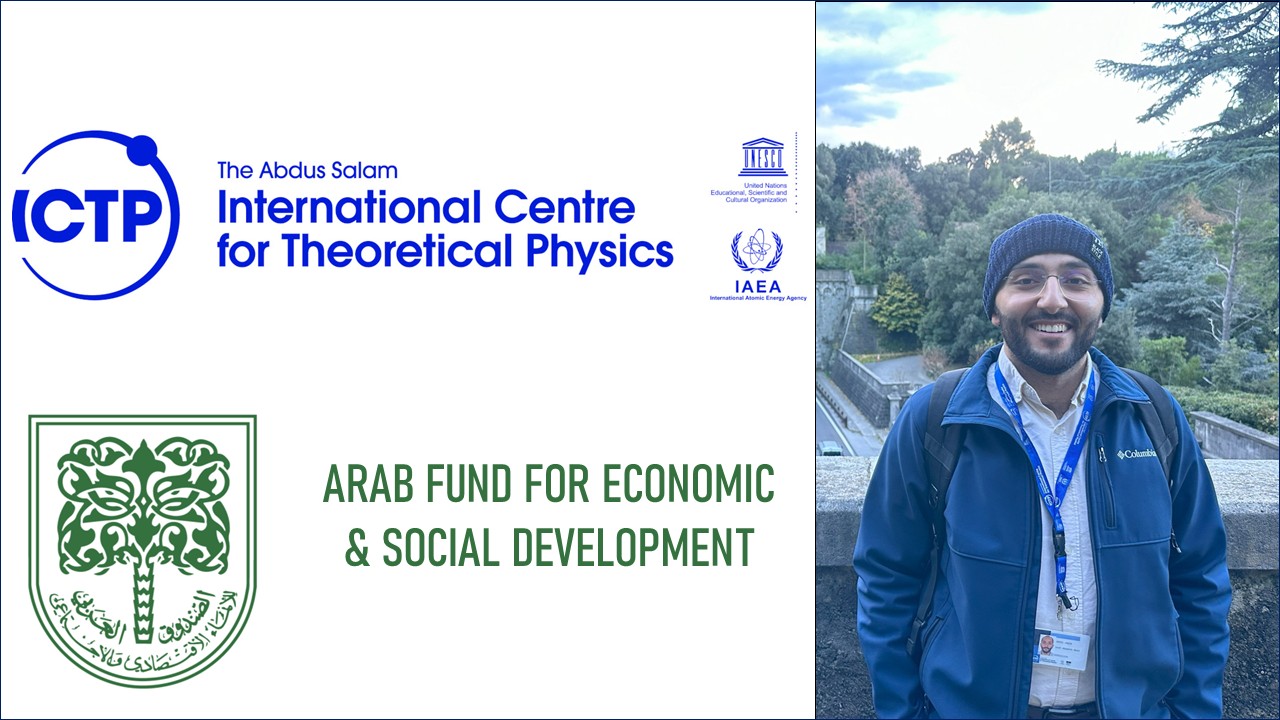
I am honored to have been awarded the prestigious ICTP-Arab Fund PhD Fellowship, part of the UNESCO ICTP/IAEA Sandwich Training Educational Programme (STEP). This competitive fellowship recognizes doctoral research focused on bridging the digital divide in the Arab region and addresses global challenges in science and technology.
About the ICTP-Arab Fund Programme
The ICTP-Arab Fund Programme is a collaboration between the International Centre for Theoretical Physics (ICTP) in Trieste, Italy, and the Arab Fund for Economic and Social Development to advance scientific capabilities of Arab researchers and students. ICTP, governed by the IAEA, Italy, and UNESCO, is a UNESCO Category 1 Institute dedicated to fostering international scientific cooperation and supporting scientists from developing countries.
About the STEP Fellowship
The ICTP/IAEA Sandwich Training Educational Programme (STEP) is designed to strengthen the scientific capability of young researchers from developing countries to contribute meaningfully to their home countries’ scientific, technical, and economic development. The fellowship follows a proven “sandwich” model: students remain enrolled at their home universities but visit host research institutions for focused collaborative research.
STEP Fellowship Structure and Selection
The ICTP/IAEA Sandwich Training Educational Programme (STEP) is designed to strengthen the scientific capability of young researchers from developing countries to contribute meaningfully to their home countries’ scientific, technical, and economic development. The fellowship follows a proven “sandwich” model: students remain enrolled at their home universities but visit host research institutions for focused collaborative research. Fellowships are awarded for up to 3 years, with 3–6 month visits per year. The programme evaluates applicants on the merit of their thesis research proposal, emphasis on addressing real-world problems with global relevance, and potential to benefit their home country’s scientific development. Priority is given to young researchers and women scientists.
My Research: DTN for Bridging the Digital Divide
My research focuses on “Delay Tolerant Networking (DTN) as a Cost-Effective Solution for Extending Internet Connectivity in Rural Areas.” This work addresses one of the most pressing challenges facing many developing countries worldwide: the persistent digital divide that prevents millions from accessing education, healthcare, and economic opportunity.
The problem
Rural and remote areas lack the infrastructure, such as fiber, 5G towers, satellite ground stations, which is needed for always-on internet connectivity. Traditional deployment costs are prohibitive relative to sparse populations and limited economic returns, leaving billions with no access to digital services.
The DTN-based solution
Delay Tolerant Networking offers a pragmatic alternative by repurposing existing transportation infrastructure as mobile data relays. The approach involves:
- Equipping vehicles (minibuses, informal transit, delivery trucks) with low-cost DTN nodes
- Leveraging regular mobility patterns of these vehicles as they travel predictable routes
- Creating store-carry-forward chains where data is buffered, carried between communities, and delivered asynchronously
- Enabling Internet-like access to education, commerce, and services without continuous connectivity
Two research projects advance this vision:
Project 1: DTN for Educational Equity Focuses on delivering digital learning content to rural schools using transport networks as data mules. The system enables asynchronous access to videos, interactive lessons, and quizzes, while collecting learner progress data for instructor feedback. Learn more: DTN for Equitable Digital Learning in Rural Areas
Project 2: DTN for Public Transport Connectivity Investigates how informal public transport systems can provide Internet-like connectivity to remote regions. Research combines analytical modeling with real-world mobility datasets from Nouakchott, Accra, and Addis Ababa to quantify system performance. Learn more: DTN for Rural Connectivity via Public Transport Systems
Collaboration with ICTP
As part of the fellowship, I will collaborate with Dr. Marco Zennaro and his team at ICTP’s Science, Technology, and Innovation (STI) group over the three-year period. This partnership will:
- Provide access to ICTP’s world-class research facilities and international scientific community
- Enable collaboration with leading DTN researchers and wireless communication experts
- Offer mentorship and training in research communication and publication
- Support validation and refinement of DTN prototypes and system models
Alignment with KAUST UNESCO Chair
This fellowship reflects the values of the KAUST UNESCO Chair on Education to Connect the Unconnected, which I am part of, and the broader commitment to addressing global challenges in connectivity and education equity. The research directly supports the Chair’s mission to develop communication technologies for underserved and remote environments, ensuring inclusive access to information, education, and opportunity across the globe.
Impact and significance
The work has the potential to:
- Reduce the digital divide by offering a low-cost, practical connectivity solution
- Democratize education by making digital learning resources accessible to remote communities
- Strengthen local economies by enabling e-commerce and digital services in underserved areas
- Create a replicable model that can be adapted to other developing regions worldwide
References
For more information about these opportunities and programmes: