DTN for Rural Connectivity via Public Transport Systems
Published:
Project overview
In today’s digital age, access to the Internet is essential for education, commerce, healthcare, and civic participation. Yet a significant digital divide persists, particularly in rural areas of developing nations where the cost of deploying traditional infrastructure (fiber, towers, backhaul) is prohibitively high relative to the sparse population and low revenue potential.
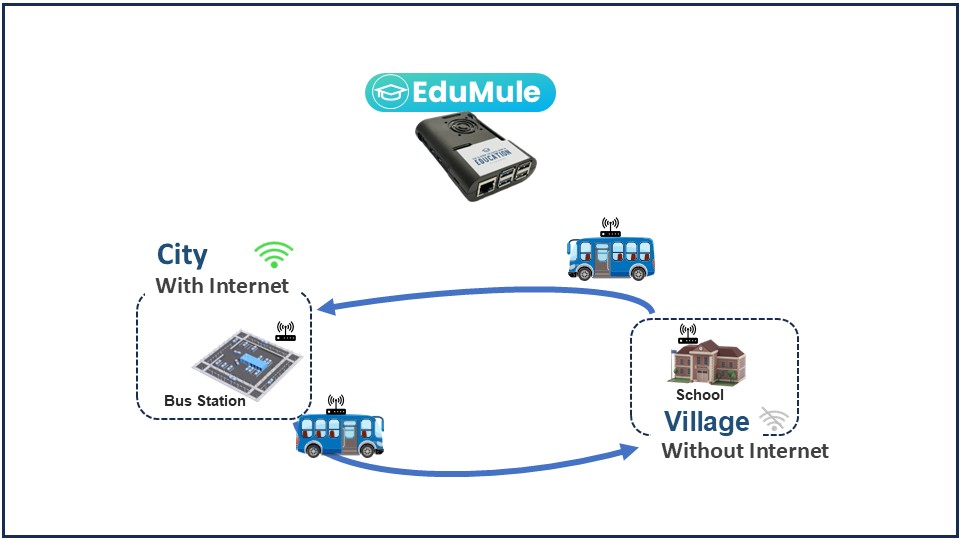
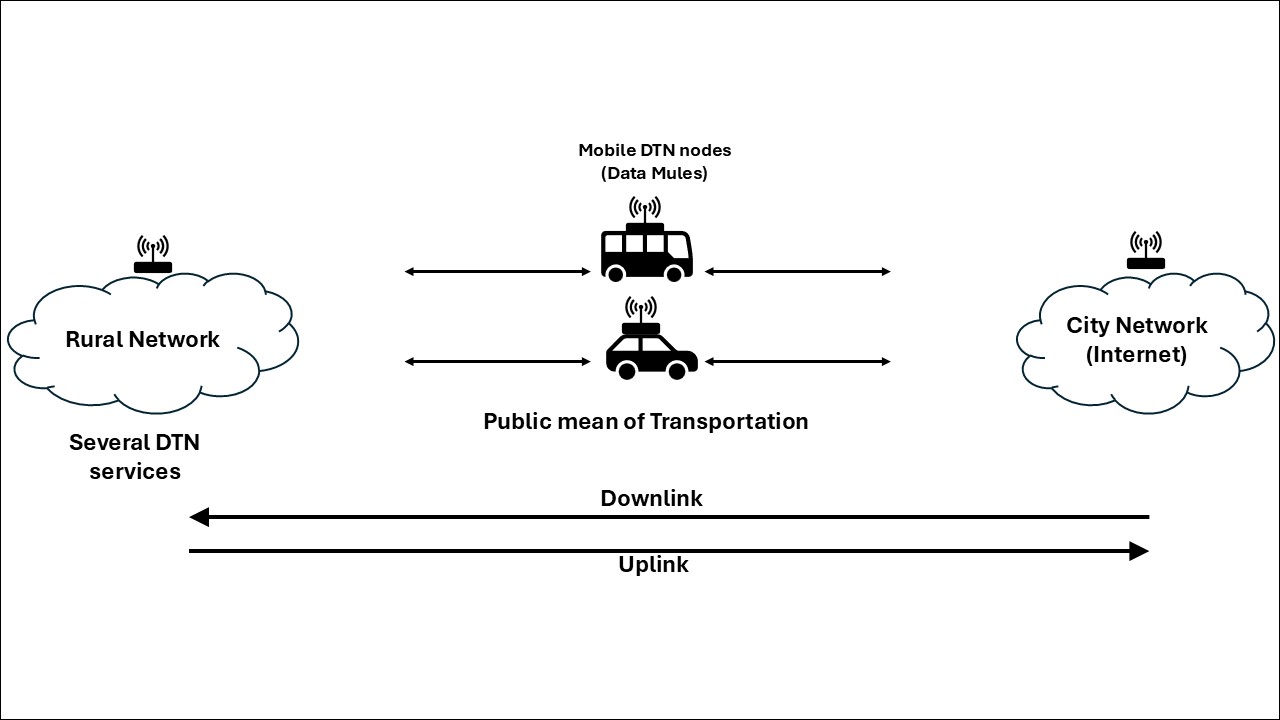
This project investigates how informal public transport systems, such as minibus taxis and shared transit, can act as data mules to provide Internet-like connectivity in these underserved regions. By equipping vehicles with simple DTN hardware, we can leverage the existing mobility patterns of these networks to carry data between disconnected communities and Internet gateways, without requiring new infrastructure or costly spectrum licenses.
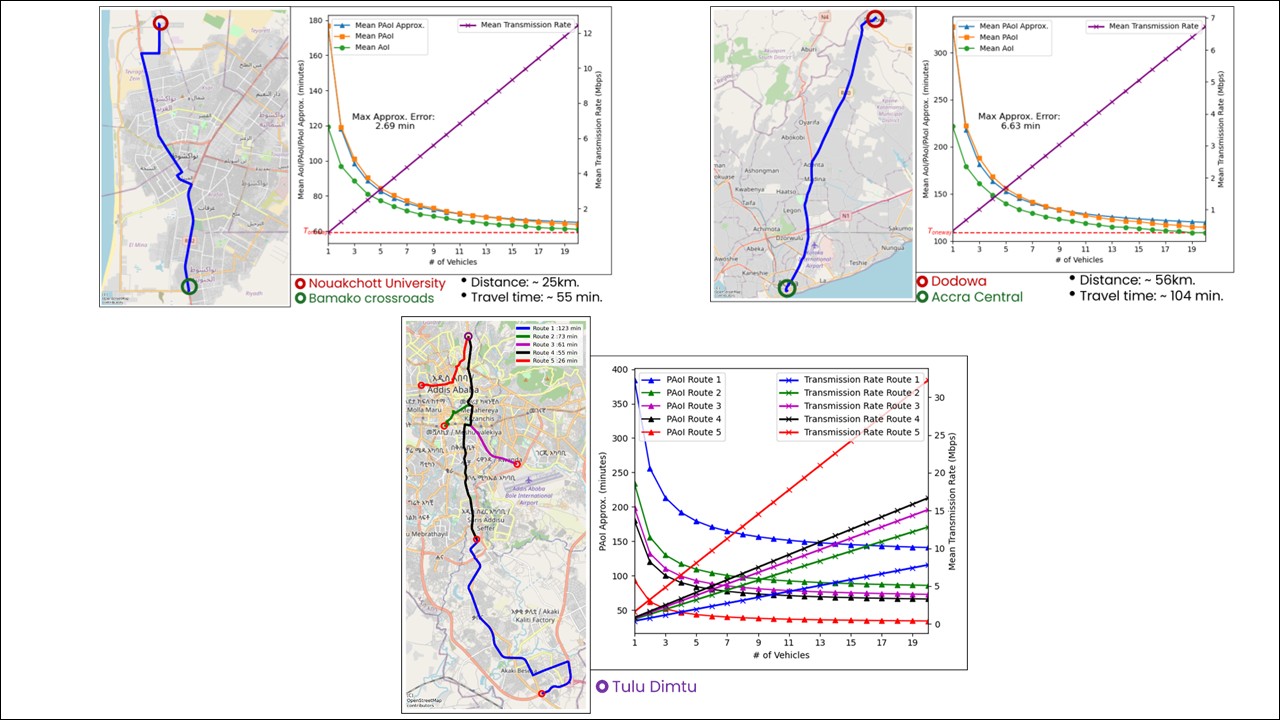
The work is grounded in the paper “Delay-Tolerant Networking to Extend Connectivity in Rural Areas Using Public Transport Systems: Design And Analysis,” published in the IEEE Internet of Things Journal. It combines analytical modeling with real-world mobility datasets from Nouakchott, Accra, and Addis Ababa to quantify system performance and demonstrate practical feasibility.
Quick links
- IEEE IoT Journal paper: Read the paper
- PDF: Download the PDF
System concept
The core idea is to use vehicles (for example, minibuses and informal transit) as mobile relays that carry data between disconnected communities and Internet gateways. Vehicles equipped with low-cost DTN nodes act as store-carry-forward relays: they pick up data bundles at one location, carry them during their regular routes, and deliver them when they reach another contact point.
The system is designed to work with the inherent randomness of informal public transport, where vehicle schedules are often irregular and travel times vary. To model this, I developed a probabilistic framework that captures:
- Random vehicle arrival times at bus stops and villages.
- Variable contact durations influenced by passenger boarding/alighting and driver rest periods.
- Stochastic travel times between locations based on road conditions, traffic, and route deviations.
The model then quantifies system performance using practical metrics:
- Average data transmission rate: How much data can realistically be moved per unit time.
- Peak Age of Information (PAoI): How stale the data becomes before a fresh update arrives.
- Mean PAoI (MPAoI): An analytical approximation validated through simulations, providing insights into long-term information freshness.
These metrics help answer critical design questions: How many vehicles are needed? How should content be prioritized? What is the trade-off between data volume and freshness?
Results highlights
The work delivers both theoretical contributions and empirical validation:
-
Analytical expressions for average data rate and Peak Age of Information in transport-based DTN systems, providing closed-form insights into how system parameters (vehicle frequency, contact duration, route structure) affect performance.
-
Real-world case studies using mobility datasets from Nouakchott (Mauritania), Accra (Ghana), and Addis Ababa (Ethiopia), demonstrating that existing public transport networks can provide tens to hundreds of kilobytes per second of aggregate throughput across multiple routes.
-
Scalability analysis showing how performance improves with route density and vehicle frequency, and how the system degrades gracefully when contact opportunities are sparse.
-
Evidence that leveraging existing transportation infrastructure can bridge the digital divide by providing reliable, low-cost, Internet-like connectivity to remote areas without requiring new cellular towers, fiber deployment, or licensed spectrum.
Recognition and outreach
This project is part of a broader DTN research line aimed at bridging the digital divide in remote areas.
- ICTP-Arab Fund PhD fellowship: I won the ICTP-Arab Fund PhD fellowship for a proposal tied to this DTN research line. Announcement
- Falling Walls Lab KAUST 2025 finalist: See the award page and presentation materials here: Falling Walls 2025
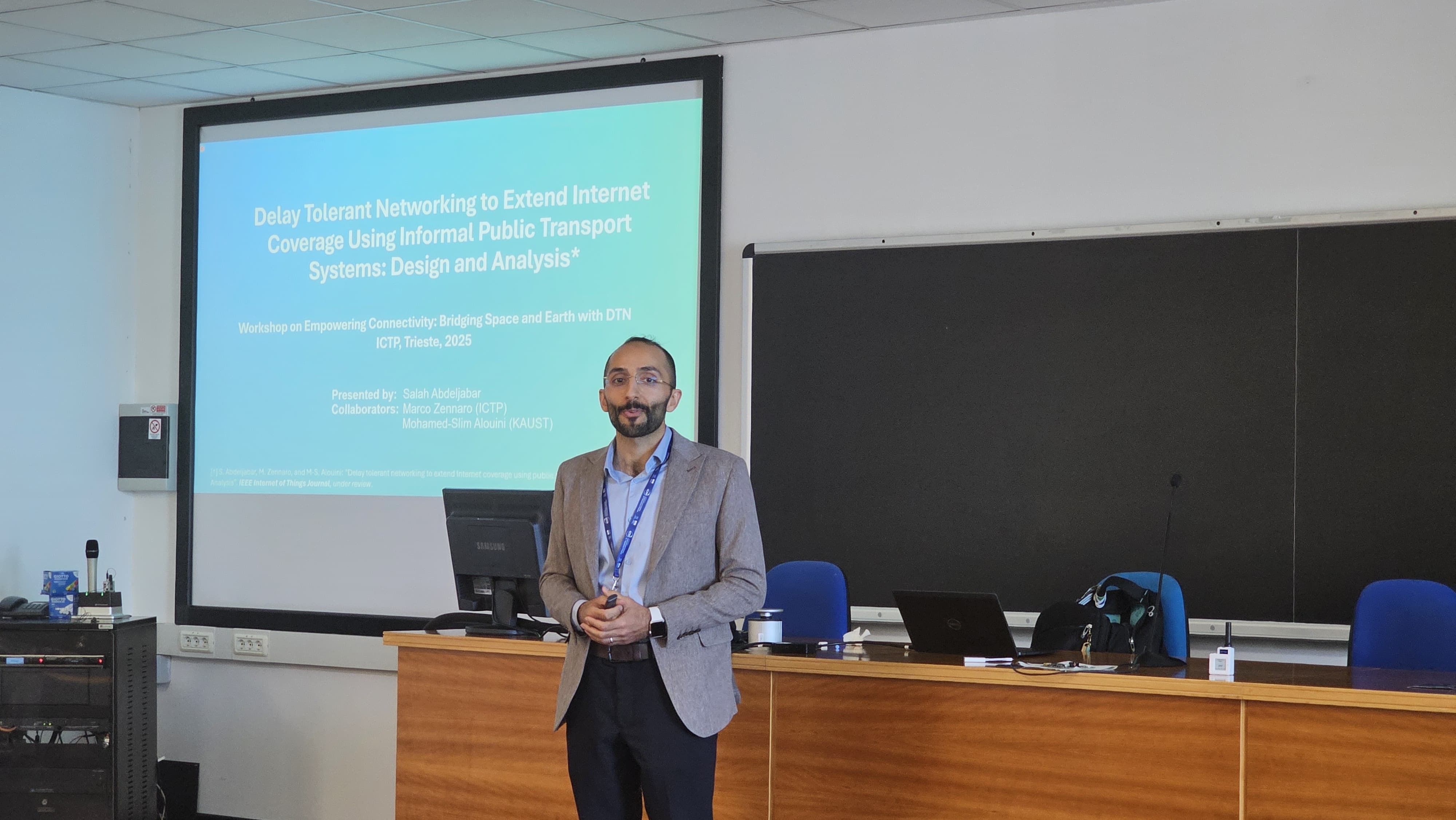
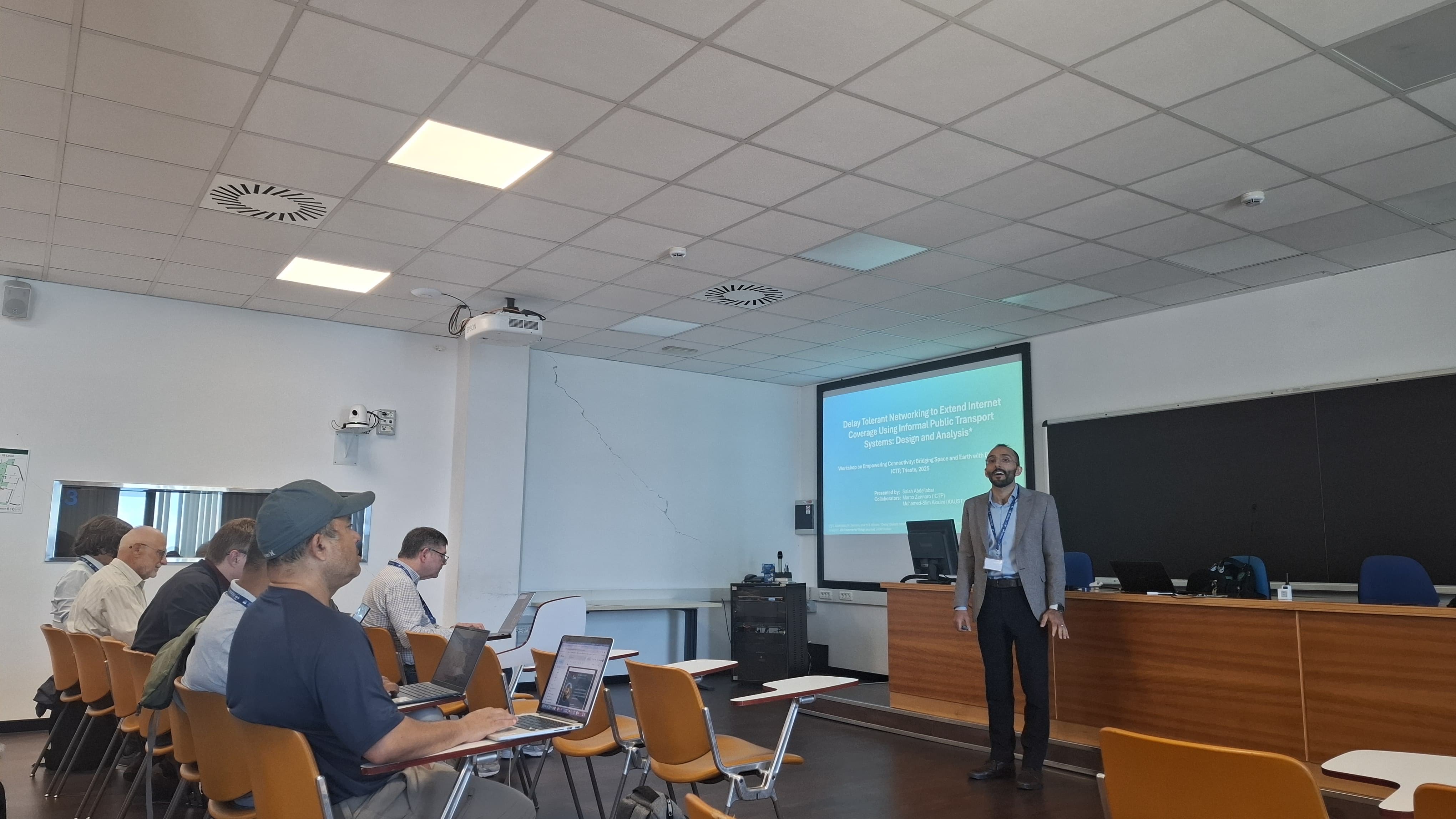
- Invited talk at ICTP: presented “Delay Tolerant Networking to Extend Internet Coverage Using Informal Public Transport Systems: Design and Analysis” at the Workshop on Empowering Connectivity: Bridging Space and Earth with DTN, ICTP, Trieste, Italy (Sep 2025). Slides (PDF) — see the full write-up and photos on the Talks page.
Related project
Photo Gallery