Camera-Free Wi-Fi Human Sensing - Saudi Research Science Institute (SRSI)
Mentoring, Communication Theory Lab (CTL), KAUST, 2026

Direct mentor for a high school student at the Communication Theory Lab at KAUST during the Saudi Research Science Institute (SRSI) summer program (student’s LinkedIn post).
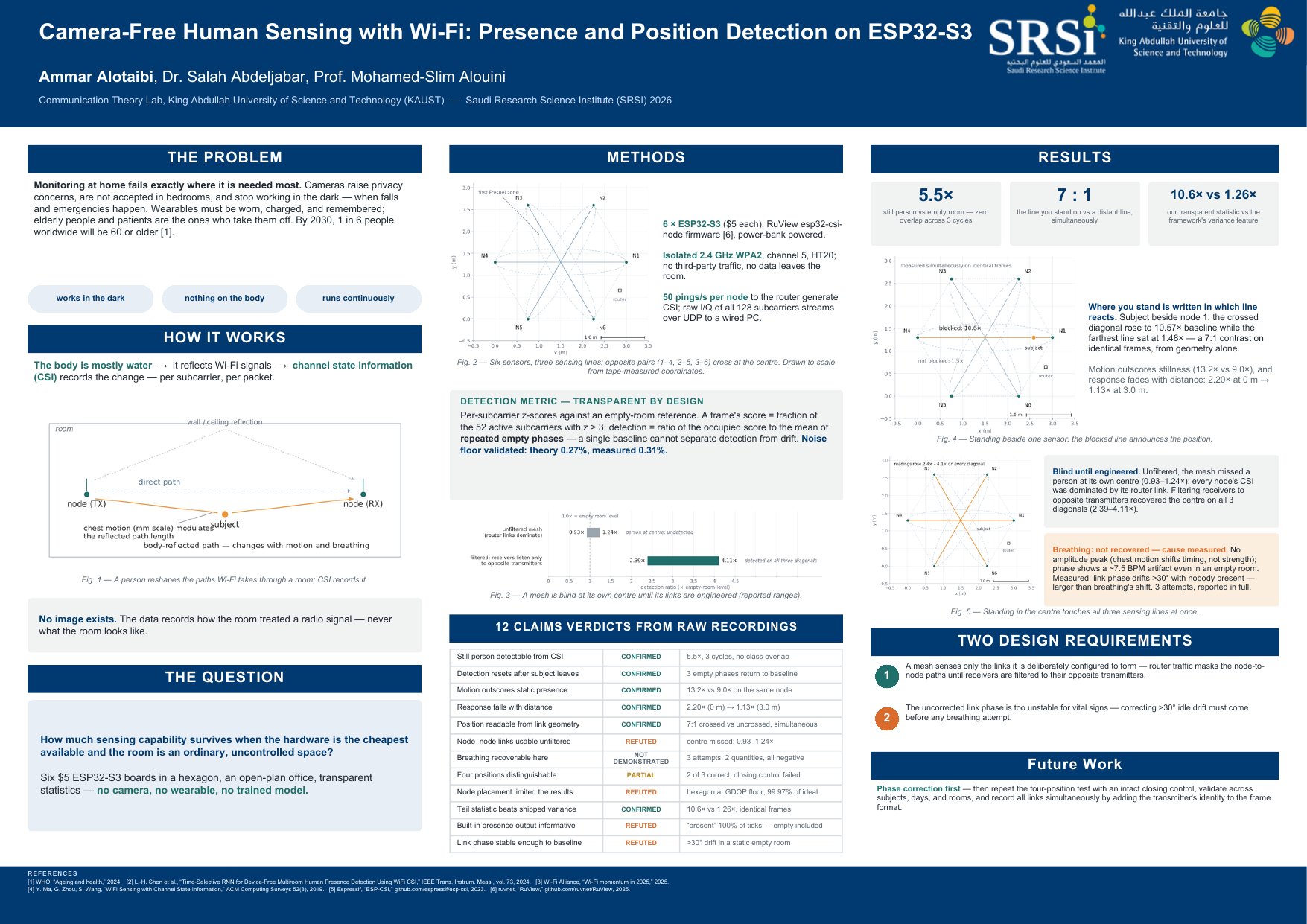
Supervised a four-week project on camera-free human sensing with Wi-Fi. Six ESP32-S3 boards sat in a hexagon around an ordinary open-plan office, streaming raw Channel State Information (CSI) over an isolated 2.4 GHz link, and every detection came from transparent statistics rather than a trained model. The question we set out to answer was how much sensing capability survives when the hardware is the cheapest available and the room is uncontrolled.
Mentoring focus
- Wi-Fi propagation and CSI: why a body reshapes the multipath, and what a single subcarrier actually measures.
- Experimental discipline: taped and tape-measured geometry, logged packet rates, repeated empty-room baselines, and a lab notebook good enough that next year’s student could rebuild the setup.
- Detection design from first principles: per-subcarrier z-scores against an empty-room reference instead of an off-the-shelf variance feature.
- Reporting negative results honestly. Breathing was not recovered, and the project measured why rather than quietly dropping the attempt.
- Ethics of sensing people without a visible sensor, and correcting the “Wi-Fi sees through walls” hype with what one antenna pair can and cannot do.
Outcomes
- Still-person detection at 5.5x the empty-room baseline, with no class overlap across three cycles.
- Coarse position readable from link geometry alone: a 7:1 contrast between the crossed sensing line and the farthest one, measured on identical frames.
- A measured design requirement: the mesh is blind at its own centre until receivers are filtered to their opposite transmitters (0.93x to 1.24x before, 2.39x to 4.11x after).
- A measured cause for the breathing failure: link phase drifts more than 30 degrees in a static empty room, larger than breathing’s own shift, so phase correction has to come first.
- Twelve explicit claims tested against raw recordings and reported with their verdicts, four of them refutations.
- A poster presented at SRSI Poster Day.
Materials
- Poster (click to view full size):