
RIS-Assisted VLC: Sum-Rate and Fairness Optimization
Published:
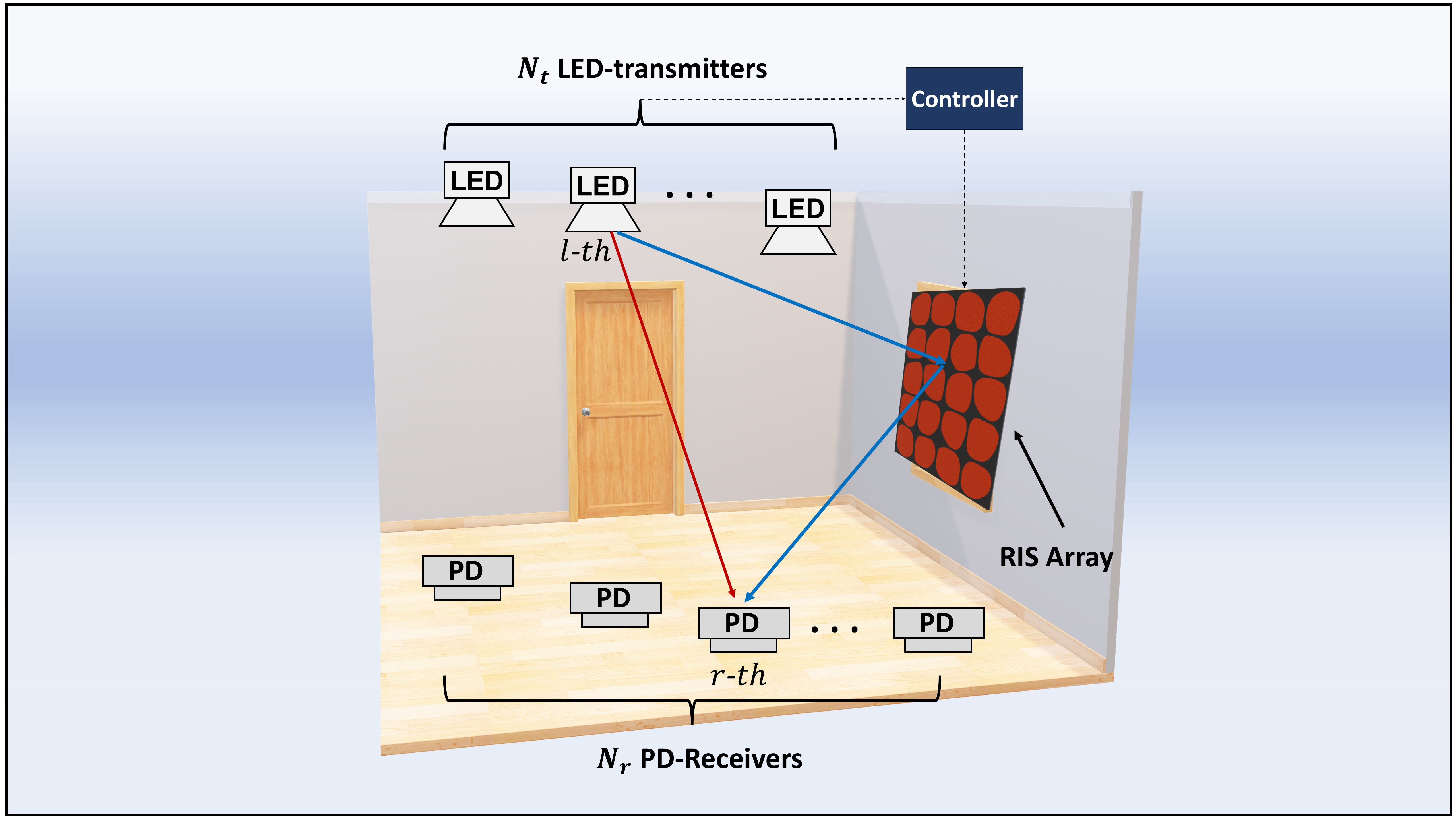
Project Overview
This project studies how to optimize Reconfigurable Intelligent Surface (RIS)-assisted Visible Light Communication (VLC) systems by jointly targeting two objectives that are usually in tension: increasing network sum-rate while preserving fairness among users with heterogeneous channel quality. The work is directly related to the publication page Sum Rate and Fairness Optimization in RIS-Assisted VLC Systems, and the full study was published in the IEEE Open Journal of the Communications Society (IEEE OJ-COMS), 2024.
Core Idea
Indoor VLC performance is strongly tied to line-of-sight (LOS) quality, so users with weak LOS links can experience low throughput and become fairness bottlenecks. This project addresses that limitation by controlling optical RIS elements to create stronger non-LOS paths and reshape the propagation environment in favor of both aggregate throughput and user-level fairness.
The paper models two RIS behaviors, namely specular reflecting elements and diffuse reflecting elements, because each offers a different trade-off between gain concentration and alignment sensitivity. The resulting optimization problems are non-convex, so the solution relies on metaheuristic optimization rather than closed-form convex methods.
For specular RIS optimization, the study uses a Genetic Algorithm (GA) to optimize element associations and improve both sum-rate and Jain’s fairness index. For diffuse RIS optimization, the study uses Particle Swarm Optimization (PSO) to tune element orientations and maintain robust performance with lower alignment requirements.
Across the evaluated scenarios, the optimization framework improves aggregate throughput, fairness across users, and outage-related reliability compared with non-optimized baselines.
System Geometry and Model
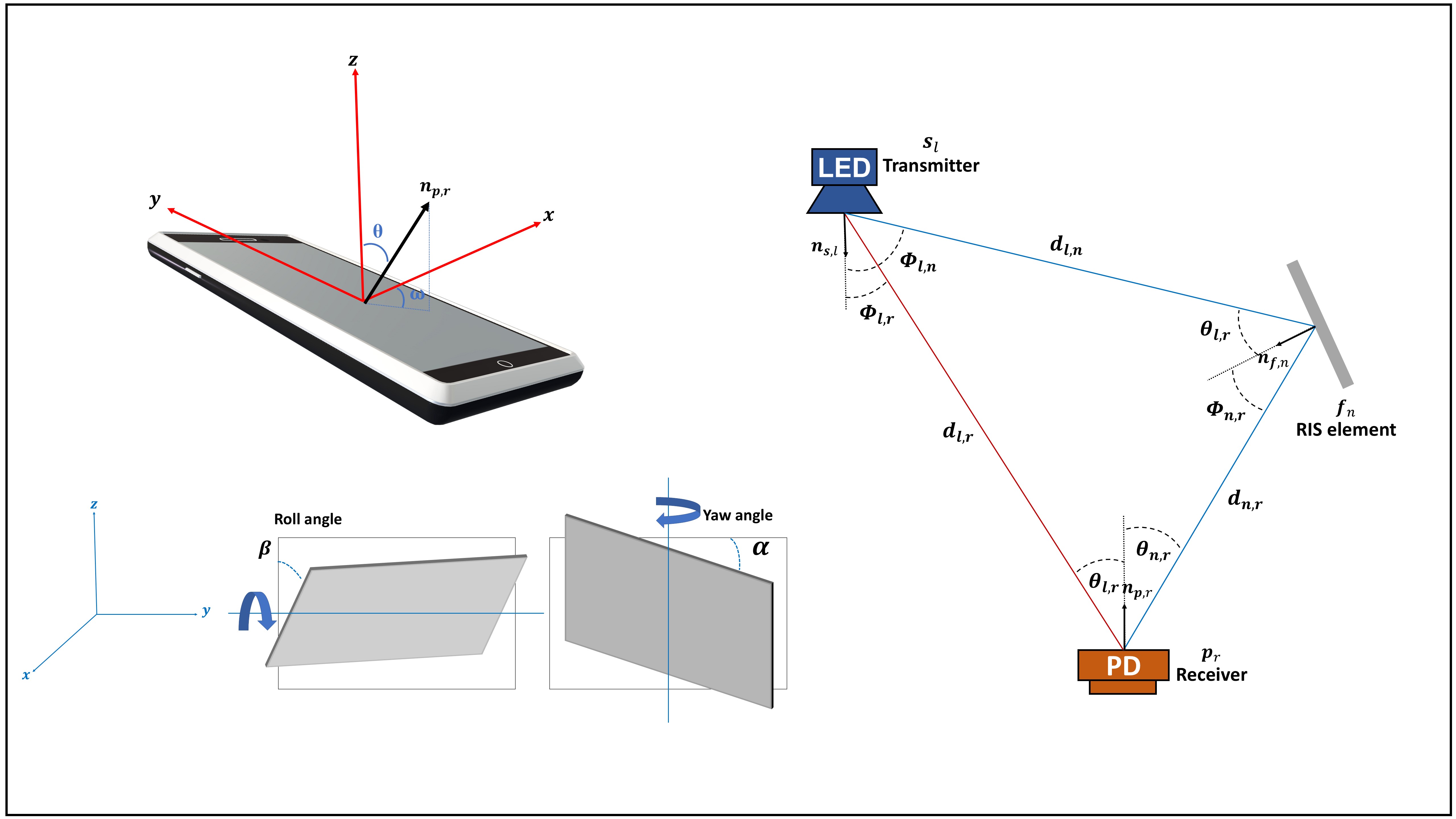
The figure above illustrates the geometric layout used in the study, including VLC transmitter-receiver LOS links and RIS-assisted reflected components. This geometry is the basis for the channel calculations and for evaluating how RIS control changes the achievable throughput distribution across users.
Main Results from the Paper
In the specular RIS setting, increasing the number of elements improves spatial diversity and strengthens reflected paths, which translates into higher sum-rate and better fairness than LOS-only operation. For the case of 144 specular RIS elements, the GA-based optimization reports sum-rate gains of 40% over LOS-only, 11% over a min-distance association baseline, and 17% over a min-LOS baseline, while fairness gains are reported at 20%, 9%, and 8% against the same references.
The paper also evaluates outage reliability using a throughput threshold, and shows that RIS optimization lowers outage probability by prioritizing weaker users through the fairness term. For 144 specular elements, the optimized scheme reduces link outage ratio by 42% compared with LOS-only, 22% compared with min-LOS, and 20% compared with min-distance.
In the diffuse RIS setting, PSO-based optimization outperforms fixed and random RIS orientation baselines and offers robustness under relaxed alignment constraints. With 144 diffuse elements, the reported sum-rate improvement reaches 100% versus random orientations and 5% versus fixed orientations, while fairness improves by 15% and 10%, respectively.
The study further shows that optimization-rate reduction can lower computational overhead with modest degradation, and reports an example where decreasing the optimization frequency yields a sum-rate difference around 100 Kbps and a fairness-index difference below 0.04 under the presented conditions.
Mobility-Aware Optimization
Beyond static placement, the paper evaluates mobile-user scenarios using a random waypoint model with 0.1 second spacing between successive user positions and a maximum user velocity of 0.5 m/s. In this dynamic setting, diffuse RIS control is particularly effective because diffuse reflections reduce strict alignment requirements and remain useful under movement and orientation uncertainty.
The results emphasize a practical trade-off: running optimization less frequently can reduce computational complexity and pilot overhead, but it may slightly reduce sum-rate and fairness. This makes the framework useful for adaptive controllers that tune optimization frequency according to system constraints.
Publication
- Publication venue: IEEE Open Journal of the Communications Society (2024)
- Publication details: View publication details
- Full manuscript: Read the paper (PDF)